

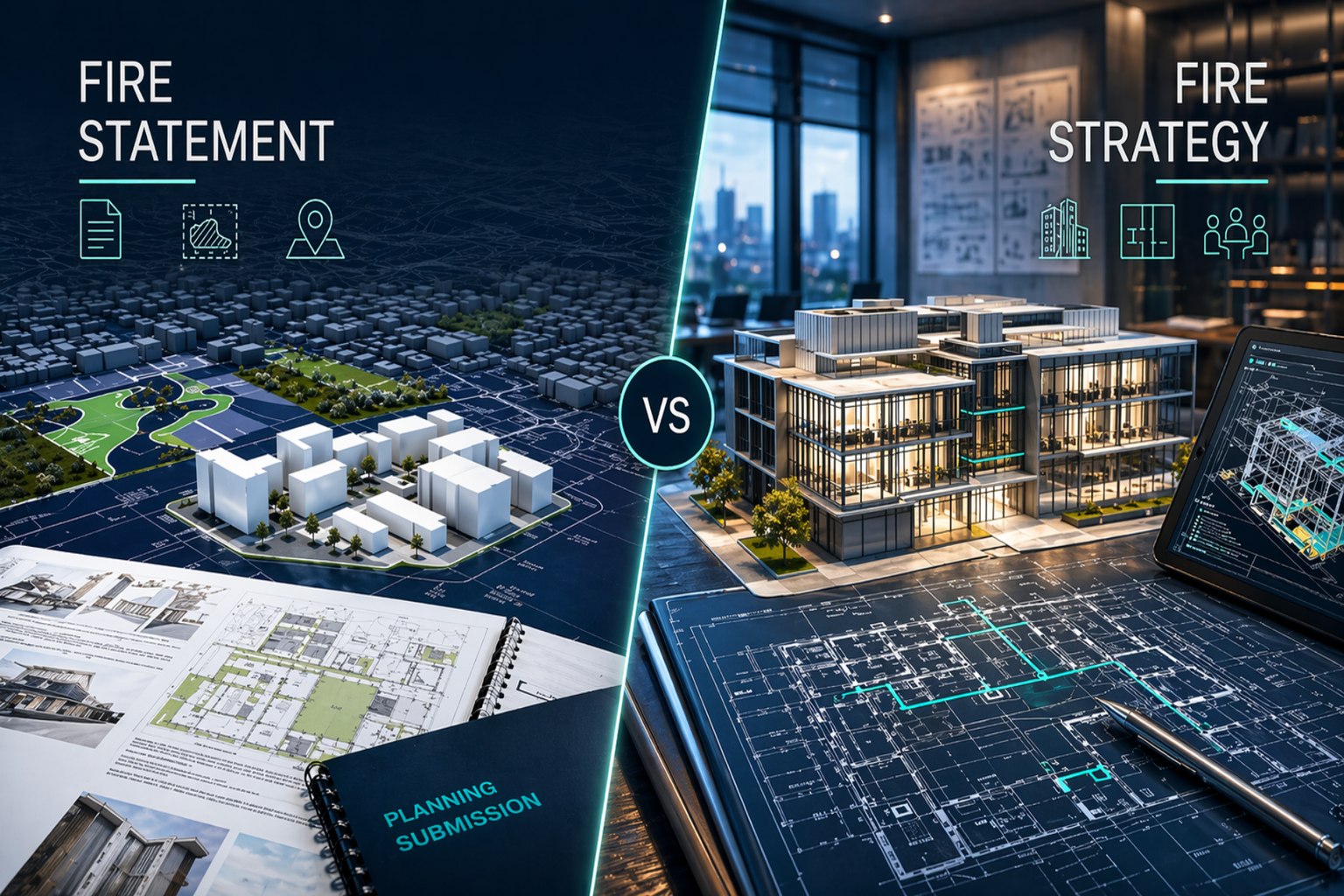
Fire Statements and fire strategies are often spoken about as though they are broadly the same thing. They are not. Confusing the two can lead to the wrong fire safety input being commissioned at the wrong stage of a project, particularly where a scheme is still at the planning stage or is beginning to move beyond it.
That confusion is understandable. Both sit within a fire safety consultancy. Both may arise early in a scheme. Both can be discussed before the design is fully developed. Even so, they do not usually serve the same purpose, and one should not automatically assume that one covers the other’s role.
Why does this cause confusion on real projects?
In practice, the confusion is often less about terminology and more about the project stage.
A client may know that fire safety needs to be addressed early, but may not yet be clear whether the immediate requirement is a planning-stage submission or wider fire strategy input for the scheme as it progresses. Because the terms sound similar, it is easy to assume they are simply two versions of the same thing. In reality, they usually sit at different points in the project journey.
This matters because a planning-stage submission may address what is needed for planning, while leaving broader design-stage fire safety issues to be addressed later. If that distinction is missed, project teams can end up working on the wrong assumptions from the outset.
What a Fire Statement is actually for
A Fire Statement is generally used to address fire safety matters relevant to a planning submission, rather than to provide the fuller and more developed fire safety framework that may be needed later in the scheme. In England, this is particularly relevant for certain higher-risk residential and mixed-use developments where planning-stage fire safety information may be expected as part of the application.
In practical terms, a Fire Statement is usually concerned with strategic planning-stage matters such as site layout, fire and rescue service access, and the broader fire safety narrative appropriate to the planning application.
Put simply, a Fire Statement is usually about what needs to be explained from a fire safety perspective at the planning stage.
That point is important because a Fire Statement is not usually intended to answer every broader fire safety question that may arise as the design progresses.
Where the fire strategy goes further
A fire strategy is generally broader in scope. It usually concerns how fire safety should be addressed within the building or development as the scheme progresses through design, coordination, technical review, and compliance development.
Depending on the nature of the project, that may include matters such as means of escape, compartmentation, internal and external fire spread, alarm philosophy, smoke control input, firefighting access, evacuation principles, and wider technical coordination with the design team.
In other words, a fire strategy is usually about how the building is intended to work from a fire safety perspective as the project develops beyond planning.
That is why a fire strategy should not usually be seen as simply another name for a Fire Statement. It is often the wider and more developed layer of fire safety input that supports the project as it moves forward.
Why the distinction matters
This is not just a technical difference in wording. It affects the brief, the timing, and the expectations placed on the fire safety input.
A scheme at the planning stage may need a Fire Statement because the immediate issue is the planning submission. The same scheme may later require broader input from the fire strategy team because the design team now requires more developed fire safety coordination and technical review.
One of the most common misunderstandings is the assumption that once a Fire Statement has been prepared, the fire safety position for the whole project has been effectively addressed. In reality, that may only be true for the planning-stage matters the Fire Statement was intended to address. Further input on the fire strategy may still be needed as the project develops.
That is where clients and project teams can come unstuck. Not because the Fire Statement was wrong, but because it was expected to do more than it was ever intended to do.
How the two may sit within the same scheme
A Fire Statement and a fire strategy are different, but they may still both be relevant to the same project at different stages.
At the planning stage, a scheme may require a Fire Statement to address the strategic fire safety matters relevant to the application. Once the scheme moves into developed design, broader fire strategy input may be needed to support the building’s more detailed fire safety principles and the wider coordination of the project team.
That is why it is more helpful to think in terms of planning-stage fire safety input and wider design-stage fire safety input, rather than assuming one document replaces the other.
A few practical examples
Higher-rise residential-led planning application
If the immediate issue is supporting the planning submission with appropriate fire safety information, a Fire Statement may be the relevant starting point. At that stage, the focus is on the planning application itself, not yet the full depth of the project’s wider fire strategy.
The scheme is moving into developed design
Once the scheme moves beyond planning, the design team may need broader input from the fire strategy team to address matters such as escape, compartmentation, firefighting facilities, smoke control, and broader technical coordination.
Client assumes the Fire Statement covers the whole project
This is one of the most common sources of confusion. A Fire Statement prepared for planning does not necessarily mean the scheme’s wider fire safety work is complete. In practice, broader support for the fire strategy may still be needed as the project progresses beyond planning.
Final thought
Fire Statements and fire strategies are related but not interchangeable.
If the immediate issue is a planning-stage fire safety submission, a Fire Statement may be the relevant requirement. If the issue is broader fire safety input as the scheme develops through design and coordination, a fire strategy is likely to be the more relevant service. In some cases, the same project may involve both at different stages.
The key question is not which term sounds more familiar. It is what fire safety input is actually needed at this stage of the project.
|
If you are unsure whether your scheme requires a Fire Statement, a fire strategy, or wider fire safety support as it develops, RSCP Engineering & Consultancy can provide clear, practical advice tailored to the stage and nature of the project. |